The biggest global vote ever to have taken place. Millions of people have already voted for their favorite "wonder." Numerous milestones have already been reached on a journey across the Internet, television and the world's media. This journey will reach its pinnacle on July 7, 2007 - 07.07.07, when the world will discover which monuments have been named as the New 7 Wonders of the World.
 The Taj Mahal (1630 A.D.) Agra, India
This immense mausoleum was built on the orders of
Shah Jahan, the
fifth Muslim Mogul emperor, to honor the memory of his beloved late wife. Built out of white marble and standing in formally laid-out walled gardens, the Taj Mahal is regarded as the most perfect jewel of
Muslim art in India. The emperor was consequently jailed and, it is said, could then only see the
Taj Mahal out of his small cell window.
 Alhambra (12th century) Granada, Spain Mohammed I
, the first king of the
Nasriden � a
Moorish dynasty in Granada - converted a 9th-century castle into his private royal residence, and it is this which we now know as the
Alhambra. The structure, which covers an area of 13 hectares, is renowned for its stunning frescoes and interior detail. The building is one of the finest examples of
Moorish architecture in the world and is among Europe�s most-visited tourist attractions.
 Angkor (12th century) CambodiaAngkor
is the most important monument of the south-east
Asian Khmer Empire and the world�s largest sacred temple. Built during the reign of
King Suryavaman, at the beginning of the 12th century,
Angkor is noted for its intricate ornamentation and striking beauty. With its water moats, concentric walls and magnificent temple mountain in the center,
Angkor Wat symbolizes the
Hindu cosmos, with its oceans at the periphery and the
Meru mountain at the center of its universe.
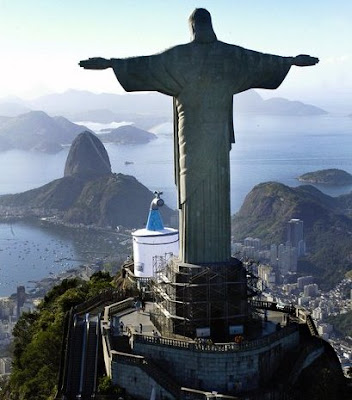 Christ Redeemer (1931) Rio de Janeiro, Brazil
This statue of
Jesus stands some 38 meters tall, atop the
Corcovado mountain overlooking
Rio de Janeiro.
Designed by Brazilian Heitor da Silva Costa and created by
French sculptor Paul Landowski, it is one of the world�s best-known monuments. The statue took five years to construct and was inaugurated on October 12, 1931. It has become a symbol of the city and of the warmth of the
Brazilian people, who receive visitors with open arms.
 The Hagia Sophia (532 - 537 A.D.) Istanbul, Turkey
The
Hagia Sophia was erected during the reign of
Emperor Justinian (532 - 537 A.D.), when the
Byzantine Empire was at the height of its power and influence. The massive dome, which is the prominent architectural feature, has since often been used as a model for the design of
Islamic mosques. Indeed, after the fall of
Byzantium, the
Hagia Sophia was converted into an
Ottoman mosque. Today, the monument is a museum serving both
Christians and
Muslims.
 Kiyomizu Temple (749 - 1855) Kyoto, Japan
Laid out in 794 A.D., the palaces and temples of
Kyoto were the residences of
Japan's emperors and shoguns for more than 1,000 years. The
Japanese Emperor is enthroned at the
Imperial Palace of Gosho. Among other significant works are the
Higashi Nonganji and
Nishi Hoganji temple complexes, the
Kinkakuji Temple with its '
Golden Pavilion' and the
Kiyomizu Temple, the temple of �clear waters.� The
Kyoto sites have been destroyed and rebuilt many times throughout history and are today among Asia's greatest cultural heritage sites.
 The Kremlin and Red Square (1156 - 1850) Moscow, Russia
Built as a residence for
Ivan I, the
Kremlin was the official residence of the
Czars until the 1917
Russian Revolution. Today, it still houses the
President�s office. In front of the
Kremlin is Red Square � an impressive and exuberant plaza which, for many people, is associated with the infamous
May Day demonstrations. Rising from the square is
St Basil's Cathedral, built in the 1550s to commemorate
Ivan the
Terrible's capture of the
Mongol stronghold of Kazan.
 Machu Picchu (1460-1470), Peru
In the 15th century, the
Incan Emperor Pachac�tec built a city in the clouds on the mountain known as
Machu Picchu ("old mountain"). This extraordinary settlement lies halfway up the
Andes Plateau, deep in the Amazon jungle and above the
Urubamba River. It was probably abandoned by the Incas because of a smallpox outbreak and, after the
Spanish defeated the
Incan Empire, the city remained 'lost' for over three centuries. It was rediscovered by
Hiram Bingham in 1911.
 Neuschwanstein Castle (1869 -1884) Schwangau, Germany Neuschwanstein Castle
was built in a time when castles and fortresses were no longer strategically necessary. Instead, it was born of pure fantasy � a beautiful, romantic composition of towers and walls in the perfect setting of mountains and lakes. The combination of various architectural styles and intrinsic craftwork has inspired generations of adults and children alike.
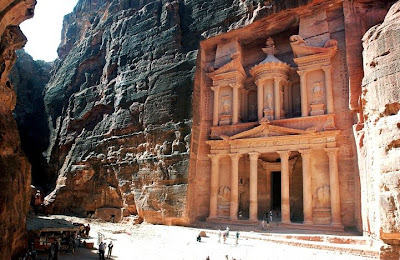 Petra (9 B.C. - 40 A.D.), Jordan
On the edge of the
Arabian Desert,
Petra was the glittering capital of the
Nabataean empire of
King Aretas IV (9 B.C. to 40 A.D.). Masters of water technology, the
Nabataeans provided their city with great tunnel constructions and water chambers. A theater, modelled on
Greek-Roman prototypes, had space for an audience of 4,000. Today, the
Palace Tombs of Petra, with the 42-meter-high
Hellenistic temple facade on the
El-Deir Monastery, are impressive examples of
Middle Eastern culture.
 The Pyramid at Chich�n Itz� (before 800 A.D.) Yucatan Peninsula, MexicoChich�n Itz�
, the most famous
Mayan temple city, served as the political and economic center of the
Mayan civilization. Its various structures - the
pyramid of Kukulkan, the
Temple of Chac Mool, the
Hall of the
Thousand Pillars, and the
Playing Field of the
Prisoners � can still be seen today and are demonstrative of an extraordinary commitment to architectural space and composition. The
pyramid itself was the last, and arguably the greatest, of all
Mayan temples.
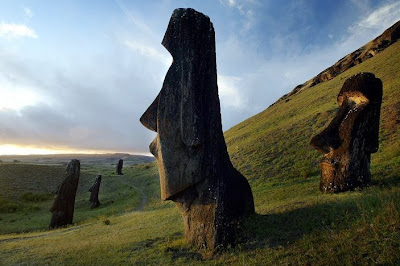 Statues of Easter Island (10th - 16th Century) Easter Island, Chile
Discovered on
Easter Sunday, 1722 by
Dutch explorer
Jakob Roggeveen, this collection of 25 meter-high
stone sculptures still puzzles historians and archaeologists as to its origins. It is believed that a society of
Polynesian origin settled here in the 4th century and established a unique tradition of monumental sculpture. Between the 10th and 16th centuries, they erected the enormous stone figures, known as the
Moai, which have long fascinated the entire world and endowed this island with a mythical atmosphere.
 Stonehenge (3000 B.C. - 1600 B.C.) Amesbury, United Kingdom
Construction of
Stonehenge took place between ca. 3000 and 1600 B.C. With each stone weighing around 50 tons, it is regarded as a truly amazing feat of engineering. Although it is not clear who built the monument, nor for what purpose, it has been speculated that it was either a temple dedicated to the worship of ancient earth deities, an astronomical observatory or a sacred burial site.
 Sydney Opera House (1954 - 73) Sydney, Australia
When the
Sydney Opera House was finished in 1973, this landmark building - in the true sense of the expression, - put the whole continent of
Australia on the world map. This building does not imitate or reflect what we generally imagine an opera house might look like, indeed, it is a completely abstract interpretation. The ability to create abstract art only developed after the invention of photography in the late 19th century, when painters first began to experiment with an abstract, cubist interpretation of reality.
 The Acropolis of Athens (450 - 330 B.C.) Athens, Greece
Built atop what is known as the �
Sacred Rock� of
Athens, the
Acropolis was to radiate power and protection for its citizens. The temples of the
Acropolis have become the some of most famous architectural landmarks of ancient and modern history. Today, the
Parthenon in particular is an international symbol of
Greek civilization. A graphic illustration of the temple also appears in the
UNESCO logo, representing culture and education.
 The Eiffel Tower (1887 - 89) Paris, France
The creation of
Gustave Eiffel, this magnificent steel tower has come to serve as a
symbol of Paris, as well as of
France itself. The structure is not only a
landmark that is recognized all over the world, but is perhaps the
most popular architectural achievement in the
Western world. It was the tallest man-made structure in the world until the
Empire State Building was constructed. The tower is visited by six million people every year.
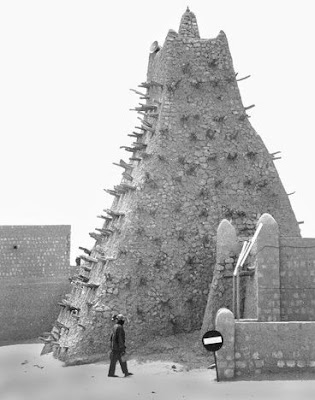 Timbuktu (12th century) Mali
In the 12th century,
Timbuktu was at the crossroads of the four most important caravan paths supplying the
Arab world, which then spanned from the
Middle East all the way to
Spain. The accumulation of wealth made it one of the wealthiest places on earth at the time. This allowed one of the first universities in the history of humankind to be established� the celebrated
Islamic university called the
Koranic Sankore, where 20,000 students studied law, medicine, rhetoric, etc. Today, it remains with us as a powerful myth and, in this way, resembles another
Ancient Wonder, the
Hanging Gardens of Babylon.
 The Great Wall of China (220 B.C and 1368 - 1644 A.D.) China
The
Great Wall of China was built to link existing fortifications into a united defense system and better keep invading
Mongol tribes out of
China. It is the largest man-made monument ever to have been built and it is disputed that it is the only one visible from space. Many thousands of people must have given their lives to build this colossal construction.
 The Pyramids of Giza (2600 - 2500 B.C), Egypt
The
Pyramids of Giza, the oldest and only
Ancient Wonder still standing, are testimony to perfection in art and design, never subsequently achieved. They were built by planners and engineers purely to serve their earthy rulers - who were also their gods. Philosophy did not exist at this time, and creation was not subject to any questioning. The
pyramids are the purest of constructions, built for eternity.
 The Roman Colosseum (70 - 82 A.D.) Rome, Italy
This great amphitheater in the centre of
Rome was built to give favors to successful legionnaires and to celebrate the glory of the
Roman Empire. Its design concept still stands to this very day, and virtually every
modern sports stadium some 2,000 years later still bears the irresistible imprint of the
Colosseum's original design. Today, through films and history books, we are even more aware of the cruel fights and games that took place in this arena, all for the joy of the spectators.
 The Statue of Liberty (1886) New York City, U.S.A.
The
Statue of Liberty was a gift of the
French government to the
United States to honor the ideals of freedom and independence. It was a very early gesture of national generosity. This huge statue became a symbol of hope and freedom for many hundreds of millions of people who immigrated to the
United States during the 20th century to find a new life of peace and prosperity.
 Ever since it was built, the Empire State Building has captured the attention of young and old alike: every year, millions of tourists flock to the Empire State Building to get a glimpse from its 86th and 102nd floor observatories. When the Empire State Building opened on May 1, 1931, it was the tallest building in the world - standing at 1,250 feet tall. This building not only became an icon of New York City,


 Rockefeller Center
 Ellis Island Immigration Museum


